

How To Clean Fused Interfacing Off Iron
How to Clean Gunk Off Your Fe (I Tested 6 Different Methods)
Ane thing that will instantly elevate the quality of your finished garments is proper ironing. I never cared for ironing earlier I started sewing, but at present that I sew almost of my own clothes, I've get obsessed with properly ironing every seam, sprint and border of my projects. All that pressing can unfortunately lead to gunk building up on the hot plate of my atomic number 26, especially if you accidentally press your atomic number 26 to the glutinous side of interfacing. This gunk buildup eventually turns brownish, which tin can and then stain the precious fabric you are using in your sewing project.
So how practice you clean that gunk off your atomic number 26? I tested six different methods for cleaning gunk off an iron, and the winner by far was Mr. Clean Magic Eraser, which was the merely cleaning method that fully removed all of the gunk from the soleplate of the iron.
What kind of gunk builds up on irons?
Before I jump into the details of the examination, a quick digression into the types of gunk that oft build up on irons. For sewists, gunk on our irons unremarkably comes from ironing the following products containing glue:
-
Fusible interfacing
-
Fusible fleece
-
Fusible web (like Stitch Witchery, Oestrus 'n Bond and Wonder Under)
-
Hem record (like Wundaweb)
-
Iron-on patches
Sewists may also get gunk buildup from:
-
Ironing cloth at besides high of a estrus setting
-
Ironing photo transfer newspaper
-
Melted plastic buttons or plastic heads on pins
I decided to test out dissimilar methods of removing the gunk buildup from all of these sources.
Setup of the test
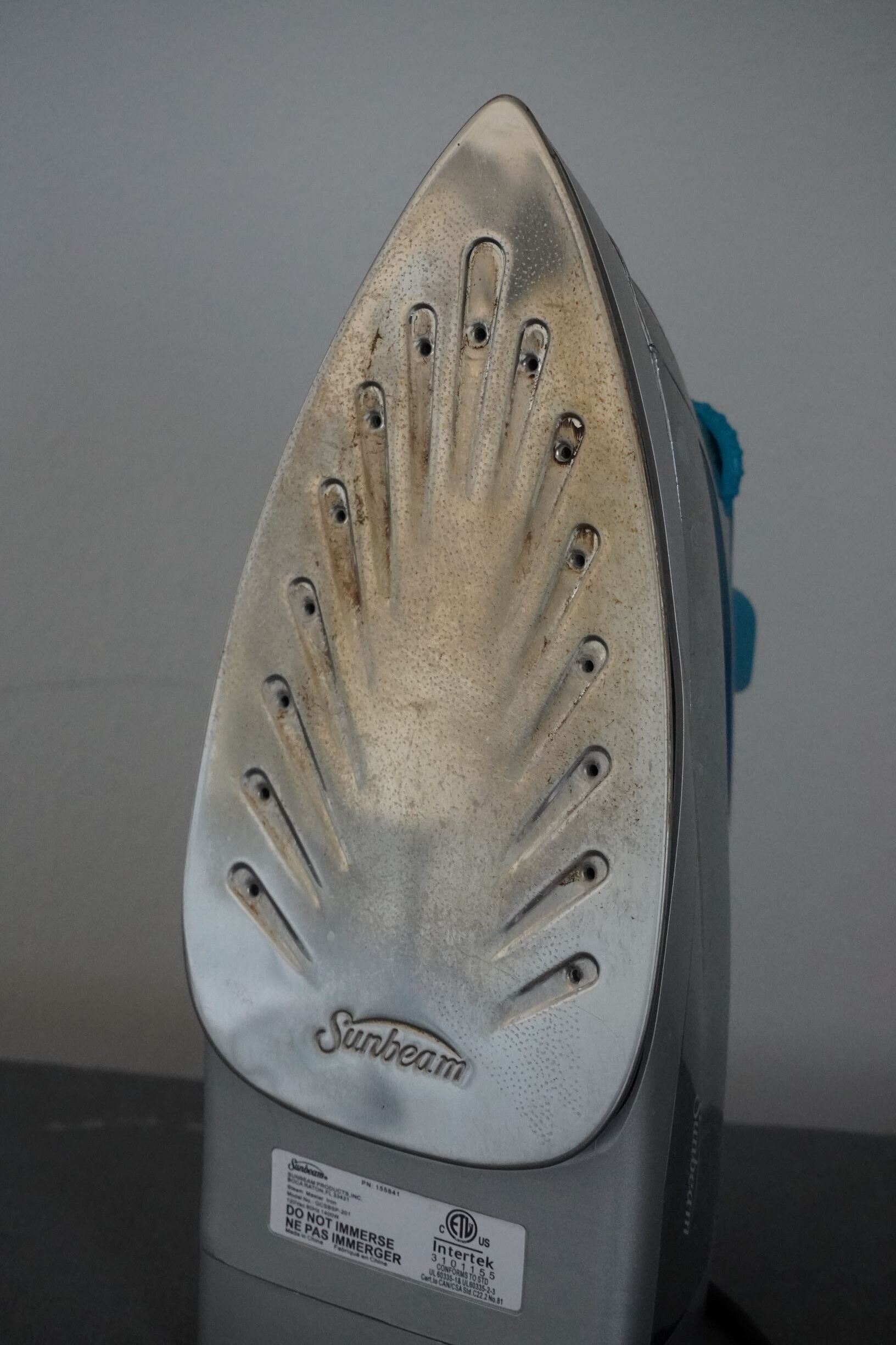
I had the perfect discipline for this test already built-in: an fe that had quite a lot of brown gunk caked on from probably over a year's worth of sewing projects. I'm not certain exactly what this gunk consisted of, but my estimate is it was a combination of glue from fusible interfacing and possibly some melted material from ironing fabrics at too high of a temperature.
To add to the gunk, I also intentionally (!) ironed the viscid side of some fusible interfacing before testing each cleaning method. That gave me a dainty fresh coat of glue each time, and so I could see if the cleaner removed it. Here's a closeup of the long-term congenital-upwards gunk + freshly ironed fusible interfacing buildup on the soleplate of my atomic number 26:
I tested the following methods for cleaning the gunk of my atomic number 26:
-
Dryer canvass
-
Dritz Iron-Off
-
Cadie Iron Bottom Cleaner Stick
-
Faultless Iron Cleaner
-
Mr. Clean Magic Eraser
-
Baking soda + vinegar paste
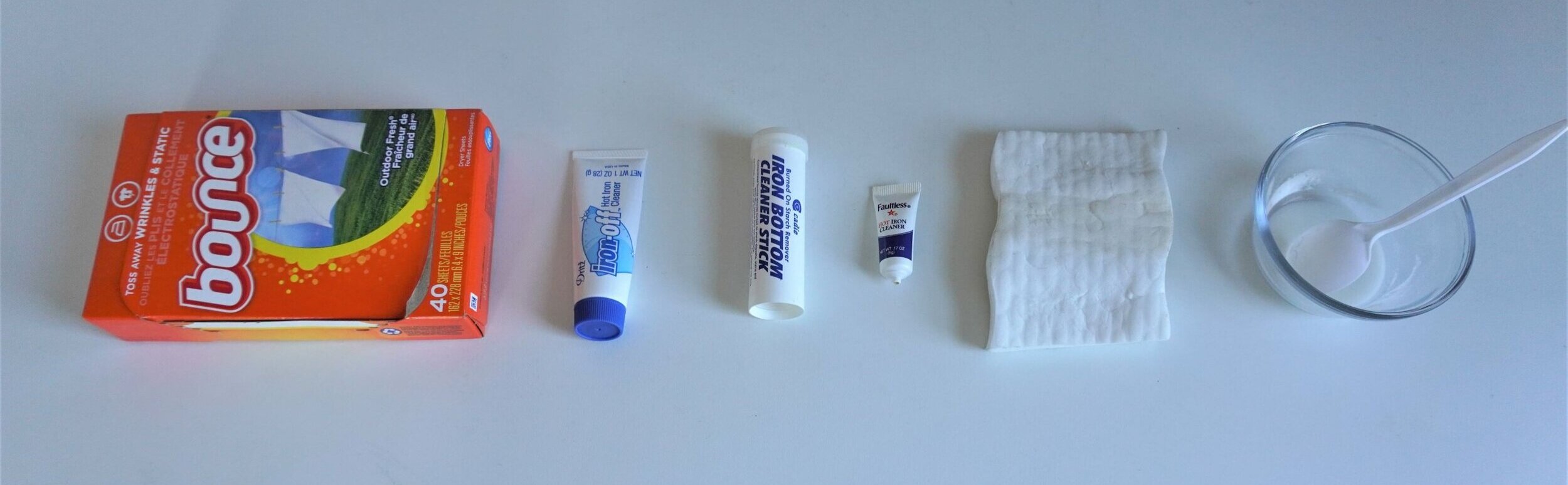
I so followed the manufacturer's instructions (or instructions found on the cyberspace, in the instance of the dryer sheet and baking soda + vinegar paste), and noted how effective the method was at removing both the freshly ironed fusible interfacing and the long-term built-upwardly chocolate-brown gunk. I also noted whether there were whatever downsides to the cleaning method.
Results of the test
Overall, I found that all of the cleaning methods were constructive at removing the gunk from the freshy ironed fusible interfacing, but just the Magic Eraser was able to remove all of the long-term built-upward brown gunk. Furthermore, the Magic Eraser was easy to use, didn't emit any nauseating fumes and didn't ruin my dish towels, unlike some of the other methods I tried. Below is a table summarizing the results of the exam:
| Removed fresh fusible? | Removed long-term gunk buildup? | Downsides | |
|---|---|---|---|
| Dryer sheet | Yes | No | Gave off terrible fumes |
| Dritz Atomic number 26-Off | Yes | No | Ruined dish towels |
| Cadie iron bottom cleaner stick | Yep | Some | None |
| Faultless atomic number 26 cleaner | Yeah | Some | Ruined dish towels |
| Magic eraser | Yes | Yeah | None |
| Baking soda + vinegar paste | ? | ? | Messy and time consuming |
I describe the results of each exam (with accompanying photos) in more detail below.
Dryer Sheet
This method was touted in the sewing forums as a quick and easy way to remove fusible interfacing from your atomic number 26, only I found it only achieved middling results in my test. Equally instructed by the internet, I set my atomic number 26 to a depression rut setting, and so passed the fe over the dryer sheet. This method worked for removing the freshly ironed fusible interfacing, merely it didn't remove the long-term congenital-up brownish gunk at all.
This method also has the serious side outcome of releasing some really terrible-smelling fumes. I don't know much about the science of dryer sheets, but I have read that dryer sheets are coated with textile softeners that are released when heated in the dryer. I suspect that when I ironed the dryer sheet, the heat from the iron released the chemicals in the fabric softener, which promptly went up my nose because I was hunched over the fe. This might be why some commenters in the sewing forums recommended using used, unscented dryer sheets, equally those sheets are likely to have fewer chemicals and fragrances.
Dritz Iron-Off
The instructions direct you to set your iron to the "cotton" setting, use a pocket-sized amount of Iron-Off to a thickly folded cloth, and then rub the hot atomic number 26 over the textile. I diligently followed these instructions, and I was able to remove the freshly ironed fusible interfacing, simply I just could not remove the long-term built-upward dark-brown gunk. I fifty-fifty repeated the process several times thinking that would exercise the trick - I practical more Iron-Off, wiped again, and repeated the procedure at least three times, but even after all that, the brown gunk was yet on my fe plate! Worst of all, the Iron-Off ended upwards ruining my dish towels, every bit the fibers of the towels became caked with Fe-Off, and the product stayed on my towels even after washing them in the washing machine (the movie below is of the dish towel after washing - the brownish patches are where the Iron-Off production was applied to the dish towel).
Cadie Iron Bottom Cleaner Stick
The instructions direct yous to rub the iron bottom cleaner stick onto the bottom of the iron while information technology is withal warm, then let the atomic number 26 cool and wipe away the remainder with a textile. The cleaner was like shooting fish in a barrel to apply and easy to remove, and it did remove the freshly ironed fusible interfacing too equally some of the long-term built-up brown gunk (but definitely not all). It too left no balance on my dish towels, which was a relief as I didn't have that many dish towels left after the Iron-Off fiasco.
I should also note that I've used other atomic number 26 cleaner sticks in the past from unlike brands (though I tin't call back the brand names right now) and had similar experiences - they are easy to utilise but they don't fully remove the really caked-on gunk.
Faultless Iron Cleaner
I have seen this product touted in several sewing forums as a miracle fe cleaning product, but I establish that this production did non work any better than the other atomic number 26 cleaning products. The instructions direct you lot to fix your iron to the "cotton" setting, clasp virtually two inches of Iron Cleaner to a towel, so rub the iron over the towel. The awarding method was very similar to Dritz Iron-Off, and maybe unsurprisingly, the results were very similar likewise: the Faultless Iron Cleaner was able to remove the freshly ironed fusible interfacing and a bit of the long-term built-upwardly brown gunk, but there was still quite a lot of the built-up brownish gunk remaining on the soleplate, particularly the brown gunk that was in the depressed area effectually the steam vents. The Iron Cleaner as well ruined my dish towel, as the product is caked onto the fibers of the towel and I suspect it will not come up off even after washing.
Magic Eraser
I have seen Mr. Clean Magic Eraser piece of work wonders on removing stains from white tabletops, so I had high hopes that it would work to remove the gunk on my iron as well. I set the atomic number 26 on a loftier heat setting, dampened the Magic Eraser, placed it on top of a folded towel and and so passed the atomic number 26 over the Magic Eraser several times. Lo and behold: it not only removed the freshly ironed fusible interfacing, but it also removed much of the long-term built-upwardly brownish gunk! Afterward passing the atomic number 26 over the Magic Eraser several times, I switched tactics and picked upwards the Magic Eraser to scrub the soleplate directly. This allowed me to really go into the depressed areas effectually the steam vents, and eventually I was rewarded past a sparkling clean soleplate that was completely gunk-free. (I finished the process off by ironing a spare slice of cotton muslin just to make certain that any residual from the Magic Eraser was removed.) This production was far and away the nigh effective production I tried, and at that place were no downsides like ruined dish towels or baneful fumes.
Baking Soda + Vinegar Paste
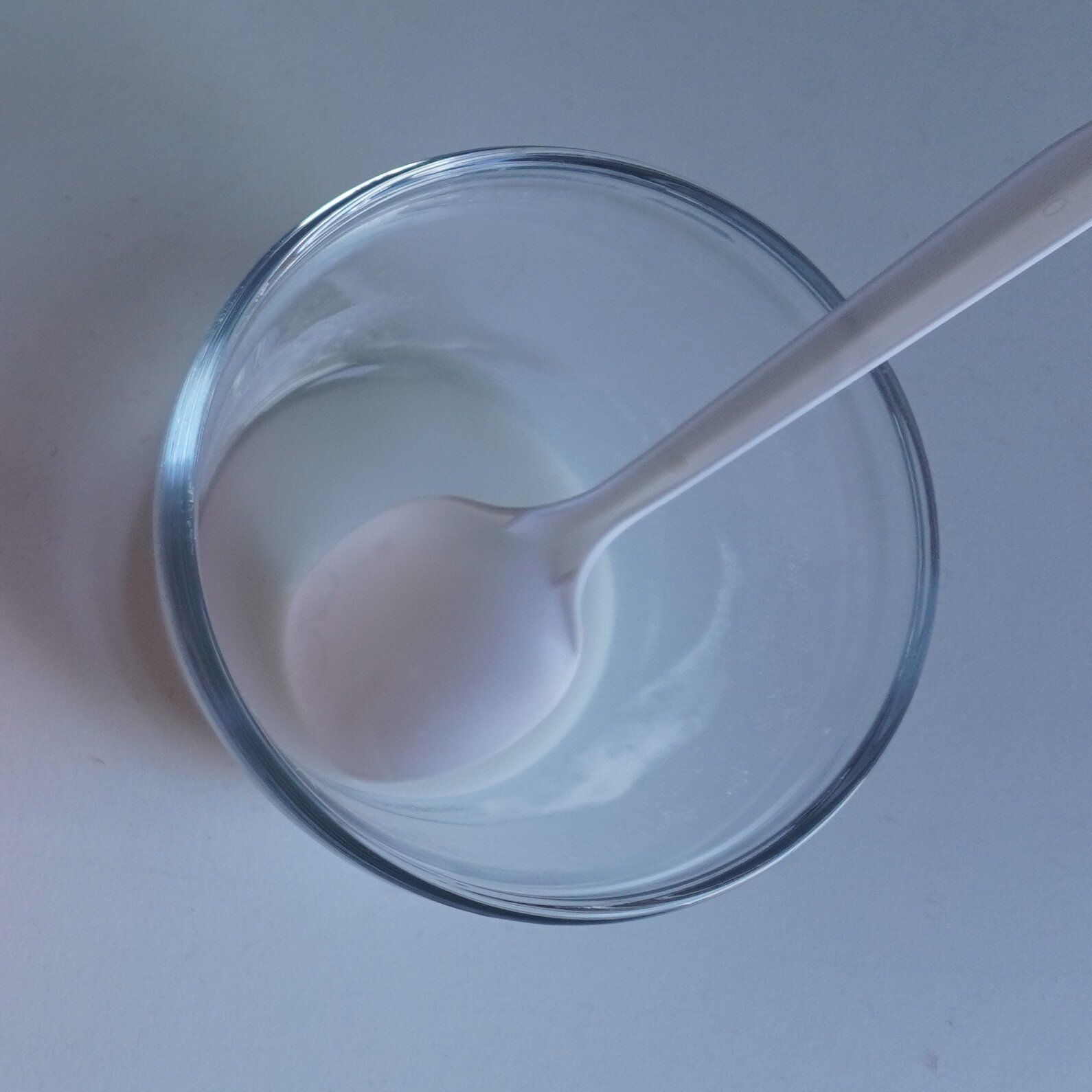
For some reason, there are a ton of websites out at that place recommending that yous use a mixture of vinegar and blistering soda to remove the gunk from your soleplate. To be honest, I didn't get to test this method because the Magic Eraser left my atomic number 26 sparkling clean so there was no gunk left to remove by the time I got to this cleaning method. However, just from a common sense point of view, using baking soda and vinegar seems like a really messy and fourth dimension-consuming way to do things - you have to unplug your fe, let it absurd down, make the vinegar/baking soda mixture, apply it to the soleplate and scrub with an one-time brush, then wipe information technology all off and plug your iron in again. No thank you. The Magic Eraser is much, much easier, and information technology won't interrupt your sewing project - yous can quickly wipe the gunk off your iron fifty-fifty while information technology is hot, and get back to your sewing project in less than five minutes.
Conclusion
The results of my test are articulate and unequivocal: Magic Eraser is by far the best choice for removing long-term gunk buildup. Having said that, I could come across keeping a used dryer sheet laying around my ironing board, and then I can quickly remove the freshly ironed fusible interfacing the adjacent time I accidentally iron the sticky side of my interfacing.
Practise I need to practise annihilation else to clean my iron?
In add-on to cleaning the soleplate of my iron, I sometimes find that chocolate-brown water starts spitting out of the steam vents of my fe, which tin can stain my textile. When this happens, I know I need to clean the inside of my iron, and I do that following these steps:
-
Mix together half a cup of white vinegar with half a cup of h2o.
-
Pour the mixture into the reservoir of a cool, unplugged atomic number 26.
-
Plug the iron in and fix it to steam; press the steam push button several times until the steam flows out freely. Let the steam menstruation for a few minutes.
-
Unplug the iron and allow to cool, so empty out water and vinegar mixture.
-
Articulate out the steam vents if there is balance blocking them. You can remove this gunk with a cotton bud or used toothbrush.
Do you agree or disagree with my findings? Let me know in the comments below!

Source: https://www.sabrina-lee.com/blog/2020/12/14/how-to-clean-the-gunk-off-your-iron
Posted by: massingillglelavold.blogspot.com
0 Response to "How To Clean Fused Interfacing Off Iron"
Post a Comment